
We all have struggled to find a way to keep track of how many calories we consume in a day. Tracking your calories is the first and most important step in your fitness journey, as calorie intake has a direct impact on weight loss, weight gain, and weight maintenance.
To lose weight, a person must burn more calories than they consume, resulting in a calorie deficit. However, in order to do so, people must first be aware of their daily caloric expenditure.
In this article, we take a look at how to count calories as well as some weight loss tips.
But first, let’s see –
What are Calories?
Simply put, a calorie is a unit of energy measurement. Calories are mainly used to determine how much energy is contained in various foods and beverages. All food contains calories. Different foods have different calorie counts, which means that each food has a different amount of potential energy.
All food that humans consume is made up of three basic types of foods- carbohydrates, proteins, and fats. The potential energy per g of these three different types of food varies.
The calorie breakdowns per gram for each food type are as follows:
- Carbohydrates have 4 calories/gm
- Proteins have 4 calories/gm
- Fats have 9 calories/gm
Calorie Deficit
Calories have two outcomes: they are either used for work and body function, or they are stored primarily as body fat. No matter what diet you follow, if you consume more calories than you use, you will gain weight. As a result, you must consume fewer calories than your body burns each day, resulting in a calorie deficit.
How to Calculate Calorie Deficit?
There are various scientific formulas available for calculating calories such as:
- The Cunningham Equation
- The Harris-Benedict Equation
- The Mifflin St-Jeor Equation
These equations calculate your Basic Metabolic Rate (BMR) based on your age, height, weight, and activity level.
But these formulas can be tedious as it requires a lot of calculations, instead, you can use the online calculators available to find out your BMR and TDEE.
In order to determine your calorie deficit using online calculators for weight loss, follow these 2 basic steps:
Step 1- Calculate your Maintenance Calories
The first step in calculating your calorie deficit is determining how many calories you require per day to maintain your weight, also known as maintenance calories.
Knowing your Basal Metabolic Rate (BMR) and Total Daily Energy Expenditure (TDEE) is a way to calculate your maintenance calories.
BMR is the number of calories required to maintain basic life-sustaining functions such as breathing, blood pressure regulation, and digestion of food. The Harris-Benedict formula is a popular formula for calculating BMR. But here we are using this online TDEE calculator which shows how many calories you burn each day. TDEE equals your maintenance calories.
You just have to enter your- Age, Gender, Height (in cm), weight (in Kg), and Body fat (optional).
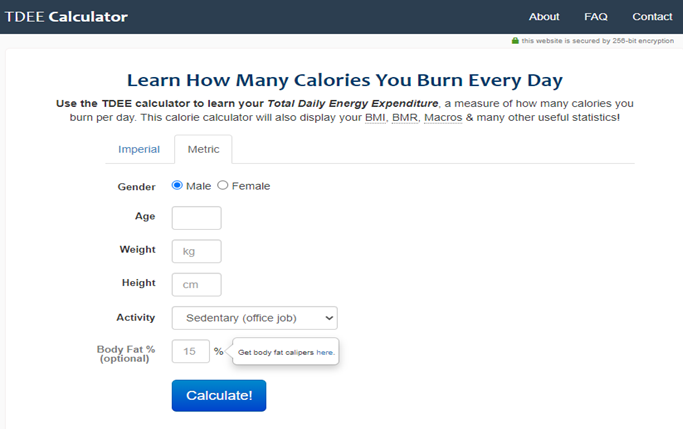
For instance, to calculate how many calories a 25-year-old, 169 cm-tall, and 65-Kg woman who is leading a sedentary lifestyle.
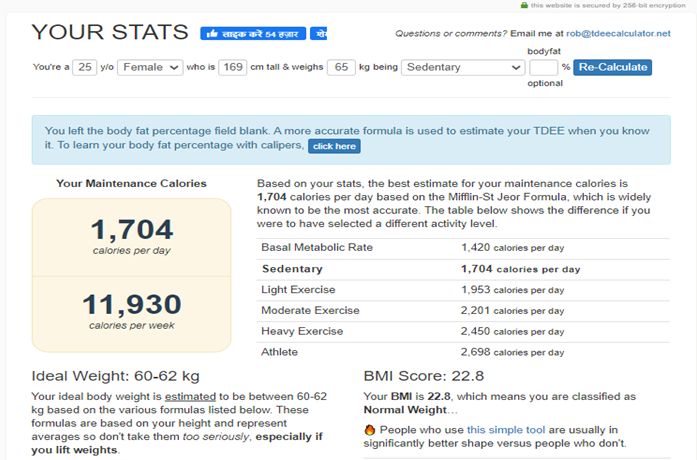
This figure shows that a woman of this age, height, weight, and activity level has a BMR of 1420 calories/day and a TDEE of 1704 calories/day. She could gain or lose weight by eating more or less than this amount over a period of several days.
Step 2- Creating Calorie Deficit
According to Mayo Clinic, you need to eat 500 calories less than your maintenance calories a day to lose 1 pound (0.5 Kg) of weight per week or increase your activity level to burn more calories than you eat. Most people use a combination of both to achieve their goals.
A dietician or nutritionist can also help you with a more personalized approach by not just calculating calories but also offering an exact understanding of your ideal calorie intake with food that is best for your health and according to your goals.
A Few Tips for Weight Loss
Aside from cutting calories, there are several steps you can take to lose weight in a sustainable and long-term way:
- Mindful Eating– this involves limiting mealtime distractions and paying close attention to the texture, taste, and smell of your dish. Moreover, this practice may help to reduce food cravings and promote long-term weight loss.
- Increase your intake of fruits and vegetables– Fruits and vegetables are low in calories but high in fibre. Furthermore, eating more fruits and vegetables may help you lose weight and increase your intake of many important nutrients.
- Stock up on nutritious foods– Following a healthy diet becomes much more difficult when your kitchen is stocked with processed foods high in sugar and calories. Rather, stock your refrigerator with a variety of nutrient-dense foods and healthy snacks.
- Try meal planning– Meal prepping is a popular way for many people to eat well while saving time. Choose one or two days to prepare your meals ahead of time so you can enjoy delicious dishes throughout the week.
Potential Drawbacks of Calorie Counting
Although calorie counting can be an effective weight-loss strategy, it’s important to remember that there are many other factors to consider when deciding what and how to eat. Rather than focusing solely on calories, it is best to eat a well-balanced diet rich in a variety of nutritious, whole foods. This can ensure that your body receives the vitamins, minerals, and nutrients it requires to support weight management and overall health.
If you do decide to cut calories, be careful not to cut them too drastically, as this can result in serious side effects such as increased hunger, dizziness, fatigue, headaches, and nausea. Eating too few calories may also slow your metabolism, making it more difficult to maintain long-term weight loss. It also takes time to lose weight in a healthy way. You should prioritize small, gradual changes over drastic weight loss strategies.
Finally, counting calories isn’t an exact science. On some days, your body requires more calories than on others. Concentrating solely on numbers and weight may also lead to disordered eating.
You should not count calories if you are facing any of the following signs-
1. You should not count calories if you have a history of binge eating or any form of disordered eating.
2. If you have tried calorie counting in the past or you’re trying right now & it’s causing you to have a lot of anxiety around food.
3. If it is making you think about food all day and every day.
4. If it makes you feel more restricted rather than giving you more freedom.
Remember calorie counting is one of the tools in the nutrition toolbox you can use different methods if you don’t find this helpful or if this is affecting your mental health.
To Wrap Up
Several different factors, including your sex, age, height, current weight, amount of activity, and metabolic health, as well as whether you want to maintain, lose, or gain weight, determine how many calories you require each day.
Although keeping track of your calorie intake may help you manage your weight, it’s also crucial to maintain a balanced diet and think about the total nutritional content of the foods you consume.
Simple dietary and lifestyle adjustments, such as getting more exercise, drinking more water, and eating more protein, may help you reduce weight and improve your health.
-Written & Edited by
Tanya Kathuria & Simran Sood